

When I watched the Disney movie “Tinker Bell,” I was surprised by how moved I was.
The story itself is a fantasy, but the theme underneath felt deeply connected to how we work and how we live.
- What is “talent” in the first place?
- Why is it so hard to notice our own talents?
- How can we work in a way that feels true to who we are?
Many people who work hard every day have probably asked themselves these questions at least once.
(I have come back to them many times myself.)
This movie quietly hides some hints for answering them.
And those hints overlap surprisingly well with Zen teachings such as 本来具足(Honrai gusoku), meaning “you are complete as you are,” and 自利利他(Jiri rita), meaning “benefiting yourself and others at the same time.”
In this article, I would like to use Tinker Bell’s story as a starting point and share my reflections on how we can make better use of our own talents.
Article summary: Key points from “What Tinker Bell teaches us about using our talents”
| Talent feels “too natural” to notice | The more natural something feels to you, the less valuable it tends to look. This is closely related to the Zen idea of 本来具足(Honrai gusoku). |
|---|---|
| Chasing others’ talents makes you suffer | When you chase the “shiny” talents of others and work hard in an area that doesn’t fit you, results don’t come and self-doubt grows. |
| Talent starts to shine when it helps someone | Your talent doesn’t shine when used only for yourself. It turns into real value when you use it for others. This is 自利利他円満(Jiri rita enman) in action. |
| What you can do naturally is your strongest asset | What you are praised for, even though you never “tried hard,” is often a sign of talent and the key to a sustainable way of working. |
| Talent is noticed, not hunted for | Your talent is not something special you must go out and find. It is already in your hands, waiting to be noticed through the right questions. |
We will walk through each of these points in more detail below.
What Tinker Bell teaches us about the nature of talent
Born with a talent(本来具足 Honrai gusoku)
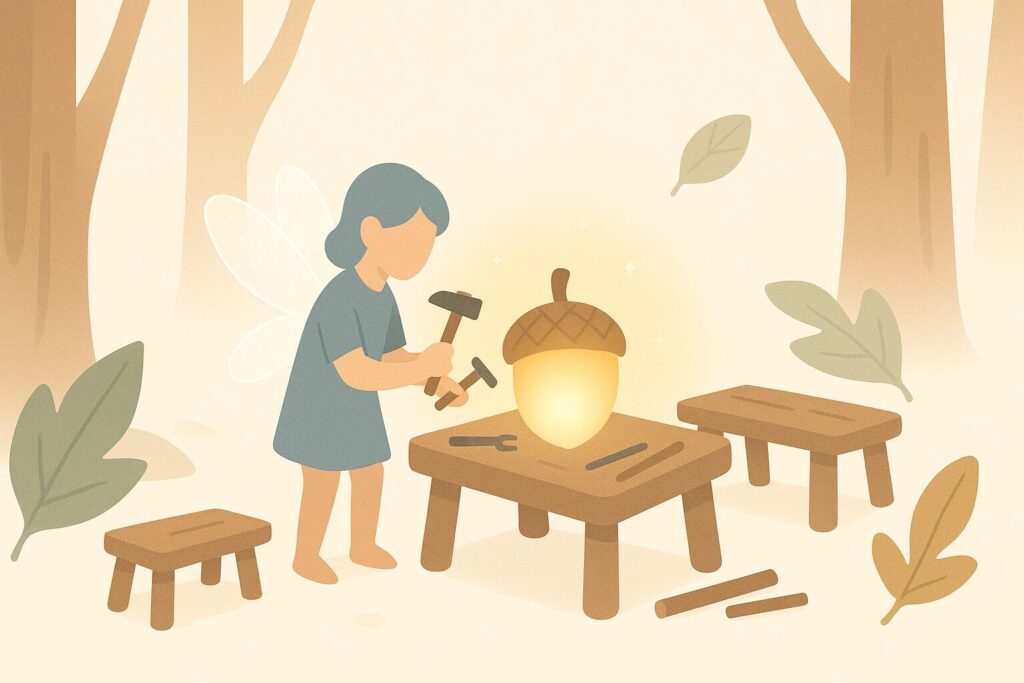
In the story, Tinker Bell is born with a talent called “tinker.”
A “tinker” is a fairy who makes and repairs things.
She uses acorns and other natural materials to craft tools and fix what is broken.
However, this talent looks “plain.”
Tinker Bell herself admires the more glamorous fairies who control light or make flowers bloom.
Here we can already see the nature of talent.
- What feels natural to you does not look special.
- It can even feel “boring” or unimpressive.
- That is why other people’s talents look so much more brilliant.
In Zen, this is expressed by the phrase 本来具足(Honrai gusoku), meaning “you already have everything you need.”
It gently points to our human tendency not to recognize what is already there.
What is 本来具足(Honrai gusoku)?
When you chase others’ “shine,” your own talent grows dim
Tinker Bell longs for the glamorous powers of the other fairies.
She keeps trying to control light or grow plants.
But none of it goes well.
- She tries hard but doesn’t see results.
- The harder she pushes, the more she feels out of sync.
- She starts to think, “Maybe I’m just not good at this.”
This is something we often see in real workplaces.
We envy others’ strengths and end up blaming ourselves.
Or we copy someone else’s “success formula” and gradually feel more and more drained.
Tinker Bell stumbles because
she is chasing a talent that is not truly hers.
The same thing happens to us.
Talent begins to shine the moment it helps someone
Near the end of the movie, a serious problem hits the fairy world.
At that moment, Tinker Bell uses her original “tinker” talent to help her friends.
This is when her talent finally shines.
- As long as she saw her skill as “plain and boring,” it never lit up.
- The moment she used it to help someone else, it turned into real value.
- And she herself felt fulfilled for the first time.
Zen calls this 自利利他円満(Jiri rita enman).
It is a state where your own benefit and the benefit of others are realized together.
What is 自利利他円満(Jiri rita enman)?
You do not sacrifice yourself, yet your actions are considerate of others.
Those actions eventually circle back and enrich your own life as well.
Our talents shine most clearly when we use them in a spirit of service to others.
That is the quiet truth this movie illustrates.
Talent often looks plain to yourself

Just like Tinker Bell felt bored by her own talent, many of us go through our work without recognizing our real strengths.
- Things you can do naturally without much effort
- Things others appreciate, yet you dismiss as “no big deal”
- Behaviors that feel completely ordinary and obvious to you
These are some of the strongest signs of talent.
Your talent is often a kind of “resource” that only you fail to notice.
And that talent works best when it is used to help someone else.
My own story: Struggling with sales, finding my place in content
Just as Tinker Bell suffered while chasing shiny talents that were not hers,
I also went through a similar period in my own business.
Trying to win at sales, even though I was bad at it

When I first started my company, I was convinced that “a truly capable CEO is someone who can sell aggressively and keep growing revenue.”
Senior entrepreneurs around me closed deals confidently and grew their businesses through sales.
Their presence was dazzling, and I felt, “I have to become like that too.”
- I bought many books on sales.
- I joined expensive sales training programs.
Yet no matter how much I tried, I saw almost no results.
The more effort I put in, the more I felt left behind.
After six months in one program, I faded out quietly.
“I’m working so hard. Why can’t I do this?”
I still remember how painful that question felt.
Looking back now, I can see that
I was fighting in a field that simply wasn’t aligned with my talent.
The original talent that had been beside me all along

At the same time, there was something I had always done naturally, without thinking much about it.
That was content creation.
- Speaking on YouTube or a podcast
- Explaining ideas clearly in a blog
- Structuring thoughts into writing
For me, these forms of content creation were not “hard work.” They were simply things I found myself doing.
I had never received formal training.
I hadn’t studied communication in depth.
Yet talking and writing felt natural.
Precisely because it felt natural, I could not see it as “talent.”
The more effortless something is, the easier it is to overlook its value.
That is exactly what happened when Tinker Bell dismissed her own tinkering skill.
How content creation made 自利利他(Jiri rita) real
Sales was painful for me because it did not fit my strengths in the first place.
“Will this feel like a hard sell?”
“Will the client dislike me for pushing too much?”
Thoughts like these weighed on me every time I went into a sales conversation.
Content, however, was different.
- People could read or watch at their own timing.
- I could deliver value without pushing anyone.
- Most of all, creating content itself was enjoyable.
Content never forces the other person.
It offers them space and choice.
And above all, my own mind felt calm.
Talking and writing were genuinely fun, and the process itself was fulfilling.
When someone told me, “Your content really helped,” I felt quietly happy.
This is exactly what 自利利他(Jiri rita) looks like in work:
a way of working that nourishes both you and the people you serve.
Just as Tinker Bell used her tinkering skill to save her friends,
I found that my own talent for “explaining things clearly” could support others.
Over time, inquiries started coming in even though I had almost stopped doing direct sales.
I was not grinding harder.
I simply noticed my talent and shifted from “for myself” to “for others.”
That single shift changed the way I work at a fundamental level.
Talent shines when you use it for others
What “There is no boring job” really means
The founder of Rakuten, Hiroshi Mikitani, once said:
“There is no boring job. There are only boring ways of engaging with your job.”
This line fits Tinker Bell’s story perfectly.
- Tinkering is not a “boring job.”
- Change how you relate to the work, and its value changes.
- Your talent shines most when you use it for someone else, not just yourself.
It is a simple but powerful way to understand the relationship between talent and work.
In the end, the problem is not that your work is boring.
The real issue is working in a way that does not use your true talents.
Working at the intersection of “talent × altruism”
Just as Tinker Bell’s talent awakened when she tried to help her friends,
our talents work best when they are aligned with a wish to serve others.
- Effort used only to satisfy yourself is hard to sustain.
- Effort that helps someone else tends to continue naturally.
- As a result, you grow more than you expected.
This is very close to the Zen idea of 無為自然(Mui shizen)—letting things unfold without forcing them, and allowing naturalness to lead to the best result.
What is 無為自然(Mui shizen)?
By doing so, you recover inner calm and a deeper sense of harmony with life.
Your talent is not something to be hunted for through strain.
Use what comes naturally to you in service of someone else.
It is already there, in your own hands.
本来具足(Honrai gusoku) ― Your talents have been in your hands from the beginning

Tinker Bell, myself,
and you who are reading this now—
Our talents have been there from the beginning.
We simply haven’t noticed them yet.
We judge them as “plain” or “not impressive enough.”
Three simple questions to uncover your talent
- What do people praise you for, even though you don’t feel you are trying that hard?
- What actions do you take almost automatically, without being told?
- Who might be happy or relieved if you used that ability for them?
If you sit with these three questions quietly,
your talent will start to come into view.
Talent is not waiting somewhere far away for you to discover it.
It is already beside you, quietly waiting for the day you finally pick it up.
That is how I see it.
Conclusion ― Your talent can become someone’s support
Tinker Bell’s story may be a fantasy,
but it speaks calmly to something very real in the way we work.
- Your talent is not something you must search for. It is already there(本来具足:Honrai gusoku).
- If you only pursue your own benefit, you suffer. When 自利(Jiri) and 利他(Rita) come together, you feel naturally fulfilled.
- The point is not comparison, but noticing the role that is uniquely yours.
- Your talent shines most when you use it to help someone else.
The talent you currently see as “ordinary” or “unremarkable”
may be exactly the light someone out there is waiting for.
Recommended reading
If this article resonated with you, you may also find the following piece helpful:
https://ceo.sigyou-school.biz/blog-en/disney-my-element-en/