
When you work,
there are days when motivation comes naturally,
and days when it simply does not.
That is true for everyone.
It depends on the type of work,
your physical condition that day,
and your mental state.
And yet, in the business world,
there is a common assumption that
“you must raise your motivation”
“lack of motivation is a bad thing”.
There are even training programs and courses
designed specifically to “increase motivation.”
I have always felt uneasy about this assumption.
When motivation is low,
do we really need to think,
“I’m not good enough” or “I should try harder”?
In this article,
I am not going to talk about how to raise motivation.
Instead,
I would like to share a different perspective:
that the moment you feel you must raise your motivation,
something may already be misaligned.
Key Takeaways: Why Work Became Easier When I Stopped Raising Motivation
| A sense of discomfort with the “motivation-first” mindset |
I have long felt uneasy with the assumption that low motivation is a “bad state.” The moment we think we must raise motivation, our direction may already be off. |
|---|---|
| Low motivation may be a signal |
Motivation is not something we can control by willpower alone. Fluctuations in motivation can be signals from your body, mind, or the nature of your work. |
| Fear-driven actions slowly drain us |
“If I don’t do this, I’ll fall behind” or “I won’t get work.” Actions driven by fear gradually wear down our mental energy. |
| What I quit was not sharing, but the “place” |
I did not stop sharing information. I stepped away from platforms that did not suit me and shifted to formats I could sustain naturally—blogs, YouTube, and podcasts. Work became easier, and results followed. |
| The goal can stay the same, the method can change |
You do not need to force yourself to continue methods that require motivation. By keeping the goal and choosing methods that fit you, results come more naturally. |
I will explain each of these points in detail below.
Questioning the Assumption That Motivation Must Be Raised

Is low motivation really a lack of willpower?
When motivation drops,
we often blame our willpower.
- I am being lazy
- I lack discipline
- Others are working harder than me
But motivation is not something we can control by willpower alone.
There are days when you did not sleep well.
Days when your body feels heavy.
Days when your mind is unsettled.
If you force yourself to push through anyway,
you may move forward temporarily,
but the backlash always comes later.
Your health suffers.
Your energy suddenly collapses.
In the long run, it often becomes a detour.
Low motivation is not a “bad state.”
It may be a signal telling you something important.
That is how I see it.
From Eastern philosophy: you may be going against the flow
In Eastern philosophy, especially in the teachings of 老子(Laozi),
the concept of 無為自然(Mui shizen), meaning
“acting in accordance with nature without forcing,”
is central.
Rather than pushing forward by force,
it emphasizes moving with the natural flow.
What is 無為自然(Mui shizen)?
Instead of forcing methods that do not fit you or your environment,
you choose directions where energy arises naturally.
By doing so, minimal effort can produce meaningful outcomes—this is the philosophy of 老子(Laozi).
Water resists when pushed,
but when you follow its current, it moves forward effortlessly.
When an action requires you to constantly “raise motivation,”
it may mean you are pushing against the flow.
Your current condition.
Your environment.
Your natural tendencies.
When these do not align,
energy does not emerge.
And yet, we try to compensate
with techniques and sheer determination.
At that point,
strain has already entered the system.
Work Driven by “I Must” Slowly Drains the Mind
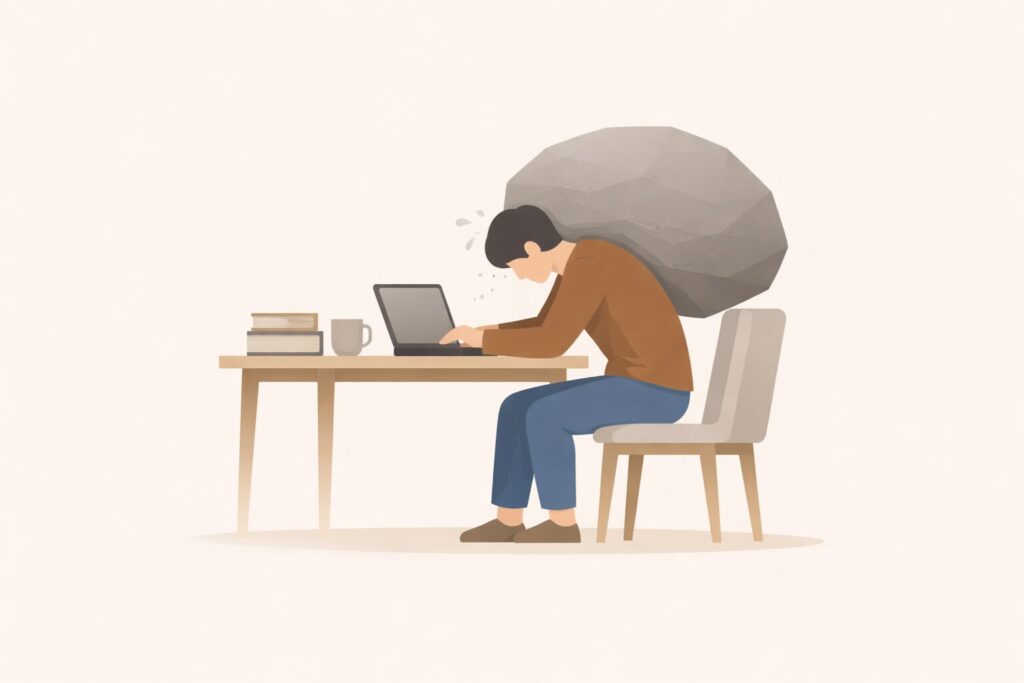
When I was trying hard on social media
When I first started my business,
a senior entrepreneur told me this:
“You should use social media—especially Facebook.”
“It builds trust if you share regularly.”
It made sense.
At the time, among Japanese entrepreneurs,
Facebook was the default platform.
I followed that advice
and kept posting for several years.
My network grew.
My follower count increased.
But at the same time,
an unspoken discomfort slowly grew inside me.
Fear-based actions become painful over time
There is a distinct atmosphere on Facebook.
- Stories of rising sales
- Photos from glamorous parties
- Displays of connections and achievements
- Curated highlights of private life
As I consumed these posts,
I gradually absorbed the belief that
“I should live like a successful entrepreneur.”
In my mid-twenties,
I moved into a high-rise apartment in Tokyo.
Looking back, that choice came from the same place.
I wanted to look successful.
I wanted to be seen as a “proper” entrepreneur.
I hosted parties in the building’s event space
and posted about them.
But honestly,
my mind grew more exhausted with time.
Does this kind of sharing really matter?
Is this what I truly want to do?
The driving force behind my posts was not
“I want to share,”
but “I feel anxious if I don’t.”
This was not natural motivation.
It was energy squeezed out of fear.
That kind of energy does not last.
Continuing with this discomfort
would not benefit my business either.
So I stopped posting on Facebook.
When I Stopped Reaching, a Different Path Appeared

What I changed was not expression, but location
When I left Facebook,
I did not stop sharing information.
- Highly visible spaces
- Noisy environments
- Places built on comparison
I simply stepped away from those.
What I chose instead were formats where I could communicate calmly:
blogs, YouTube, and podcasts.
Writing allowed me to organize my thoughts.
Longer formats let me explain context.
This approach fit me surprisingly well.
Why I stopped thinking about motivation
When I write blog posts,
I do not try to “generate motivation.”
When I speak on YouTube,
I do not push myself with effort.
- I write because I want to
- I speak because I want to
- I organize thoughts by putting them into words
Before I knew it,
the word “motivation” had mostly disappeared from my thinking.
I continued without feeling like I was trying hard.
As a result,
I began receiving messages like
“I read your blog” or “I watched your YouTube videos,”
and both inquiries and revenue increased.
You Do Not Need Motivation for What You Truly Enjoy

How children play games
When children play video games,
they do not say,
“Let’s raise my motivation and play.”
They play because they want to.
That is all.
If not stopped,
they could play endlessly.
Doing something because you want to—
this matters in business as well.
Work may follow the same structure
When something fits you,
energy emerges naturally.
The less it fits,
the more technique and pressure are required.
- How to raise motivation
- How to sustain drive
- How to avoid burnout
When such advice becomes necessary,
it may be a sign that
the method itself does not fit you.
Should You Quit Everything That Lacks Motivation?
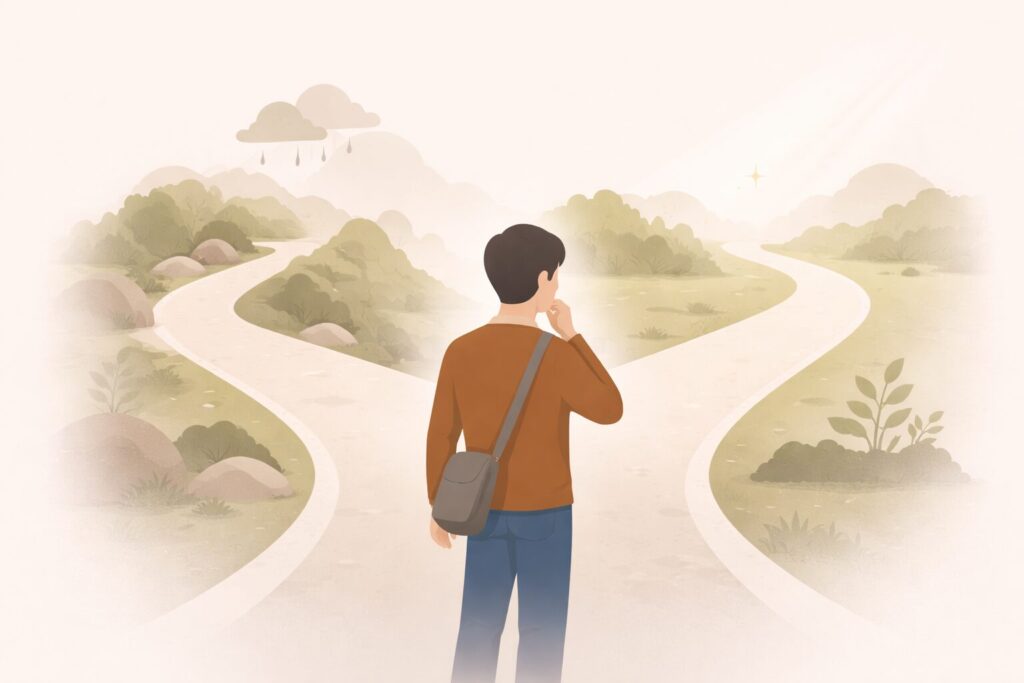
Separating goals from methods
At this point, you may wonder:
“If motivation is low, should I quit everything?”
I do not think so.
What matters is separating goals from methods.
Take exercise as an example.
You may want to move your body,
but there is more than one way to do so.
- If running is unpleasant, choose a different form of exercise
- If long sessions feel draining, choose shorter, focused ones
You do not need to abandon the goal.
You only need to change the method.
Personally,
I dislike steady, repetitive running.
But I love weight training and basketball.
Running requires motivation for me.
Weight training and basketball feel unnatural to skip.
In the same way,
there is always another method
that achieves the same goal without relying on motivation.
My choice as someone who disliked sales
In business,
I have always disliked sales.
Every time, I had to psych myself up and say,
“Alright, let’s do this.”
Continuing like that was exhausting.
So I stopped trying to overcome my dislike of sales.
Instead, I chose information sharing.
- What I already know
- Past client case studies
- Things I have tested and learned
I organize these ideas
and share them through blogs, YouTube, and podcasts.
This approach does not require forcing myself.
As a result,
people began reaching out proactively,
without any hard selling on my part.
Choosing to Question Motivation
When motivation drops,
we tend to focus on changing ourselves.
But with a small shift in perspective,
changing the method becomes an option.
- What are you forcing yourself to continue right now?
- Does that method truly need to stay the same?
- Is there another way?
- Should you consider letting it go?
Low motivation itself is not a problem.
It may be a signal
that your current approach does not fit you.
Let go of methods that require motivation,
and choose methods you want to do naturally.
That path tends to lead to better results.
This is how I see it.