

When you run a company, you may often hear a quiet voice in your head saying things like:
- “I have to grow sales more.”
- “I have to hire more employees.”
- “I should scale up the business.”
- “The bigger the company, the more valuable it is.”
At first, something about this feels a bit off.
But because everyone around us says these things, and because society equates “big = right (growing)” and “small = still incomplete,”
we start thinking we must walk in that same direction.
I was once fully inside this world where “bigger is always better.”
Then one day, I noticed something.
As I chased size and growth, the people who were supposed to be at the center of my work — my clients — started to slip out of view.
The feeling behind that discomfort became clear when I encountered a book called “Company of One(Japanese book title is StaySmall)”.
If you pursue growth at all costs, your company can turn into a “beast” that ends up devouring you.
That line pierced me.
In this article, I’d like to slowly explore — together with my own experience and some ideas from Zen —
“Why does letting go of constant expansion actually make your business healthier?”
based on what I learned from “Company of One.”
Summary: Key Points for “Not Becoming a Slave to Your Company”
| The trap of growth-at-all-costs | When you put scale above everything else, your company turns into a “beast” that ends up consuming your life as a founder. |
|---|---|
| How we become 餓鬼(Gaki:hungry ghosts) | The more you chase revenue, followers, and status, the more your heart feels empty. As the Buddhist scripture Dhammapada says, “Even if coins rained down from the sky, desire would never be satisfied.” |
| The principle of the long chopsticks | In the same environment, a mindset of “taking” creates hell, while a mindset of “giving” creates heaven. Business works the same way: 自利利他(Jiri rita), meaning “benefiting yourself by benefiting others,” is essential. |
| Revenue is a byproduct of happy customers | Revenue is not the primary goal. It appears naturally as a byproduct of careful, honest value creation. This is the core message of Company of One. |
| Staying small is a strategy | A small company is not “unfinished” — it is a deliberate choice. It is a way of working that protects your freedom, your craftsmanship, and your closeness to clients. |
Let’s look at each of these points in more detail.
When a Company Turns into a “Beast”
In “Company of One,” there is a line that says:
“When you obsess over scaling up, your company becomes a beast that consumes you.”
The moment I read it, I thought:
“This is exactly who I used to be.”
I was always chasing numbers, feeding the beast — my company — with more and more revenue.
The more I thought, “I have to grow more, I have to reach higher,” the more exhausted my heart became.
And one day I began to notice:
- Why am I really working so hard?
- Who am I actually making proposals for?
- Is this service truly for the benefit of my client?
- Or am I just feeding the beast to keep its stomach full?
When these questions start to surface, you are already being dragged around by the beast.
In other words, you are on your way to becoming a slave to your own company.
The Dhammapada, a classic Buddhist text, has a famous line:
“Even if coins rained down from the sky, desire would never be satisfied.”
Once desire is lit, no amount of money or scale will ever feel like “enough.”
Like 餓鬼(Gaki), “hungry ghosts” in Buddhism who can never be full, if you place expansion as your first and only objective, you end up trapped forever in “not enough, more, more, more.”
I was one of those people.
The more I chased numbers, the more obsessed I became with “how full the beast’s stomach was,” instead of focusing on the client in front of me.
That way of working wasn’t good for my clients — and it wasn’t good for me either.
Heaven and Hell Through the Story of the Long Chopsticks
While reading the book, I was reminded of a traditional parable called “三尺三寸箸 (San-jaku-san-zun-Bashi).”
The scene of hell
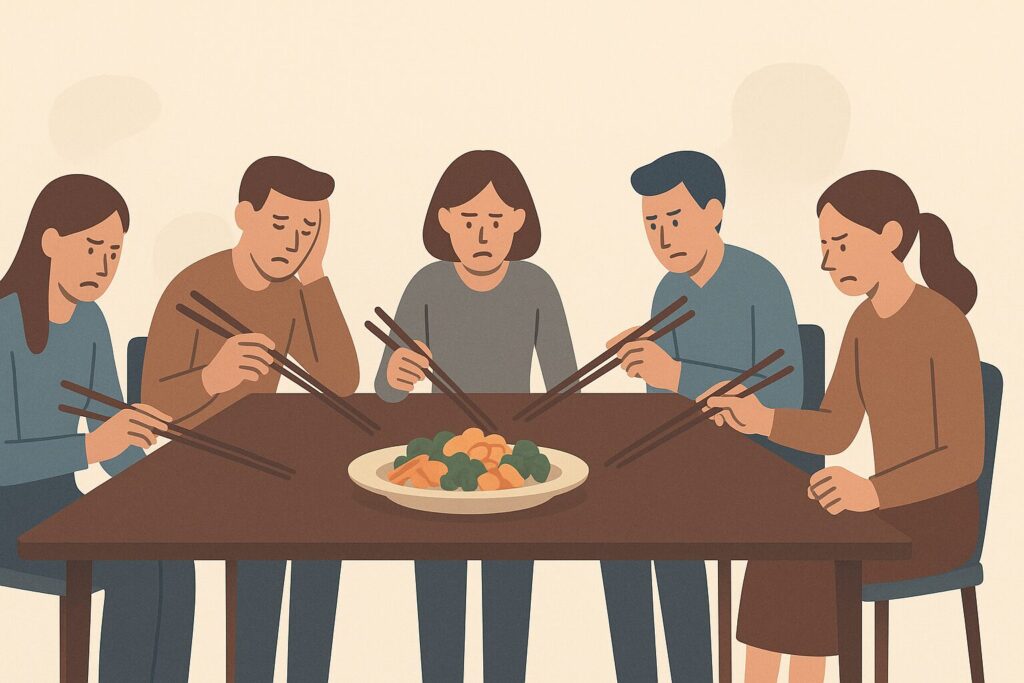
The story begins with a man who is allowed to visit both heaven and hell.
He first goes to hell, where people sit around a luxurious dining table, suffering from hunger.
There is more than enough food, yet everyone is thin, angry, and constantly fighting.
The reason lies in the chopsticks.
Each person uses chopsticks that are 三尺三寸 (San-jaku-san-zun) — about one meter long.
They are so long that no one can get the food into their own mouth.
People grab, shout, and struggle, but are never satisfied.
This is the scene of hell.
The scene of heaven

Next, the man visits heaven.
To his surprise, the scene looks exactly the same as in hell.
The same long dining table.
The same one-meter-long chopsticks.
The same kinds of dishes.
But there is one crucial difference.
In heaven, people use their long chopsticks to feed the person sitting across from them.
Because the chopsticks are so long, they easily reach the person on the other side of the table.
“What would you like to eat?”
“How about this one?”
By giving food to the other, they themselves receive food in return.
In the same environment, what separates hell from heaven is simply the direction of the heart.
When I recalled this parable, it overlapped perfectly with the message of “Company of One.”
A way of working that is obsessed with scaling up is like the table in hell.
A way of working that focuses on giving is like the table in heaven.
If you work only for yourself, you never feel satisfied.
When you work for someone else, a different kind of fulfillment appears.
And that fulfillment is quiet, deep, and sustainable.
How Working Small Brings Back “Benefit for Others”
At its core, business exists to benefit others.
- Solving your client’s problems
- Supporting someone’s future
- Providing real value
Revenue is what comes afterward.
The order is always “others → self.”
However, under constant pressure to grow, that order starts to break.
The top priority becomes the beast — the company — and you end up enslaved to it. Your client fades out of view.
That is exactly the “hell-side” of the long chopsticks.
When you choose to stay small, something changes. Benefit for others naturally returns to the center.
You can sit quietly with each client.
You can see what that person truly needs.
You can make proposals without inner conflict.
And as you do, your own mind gradually calms down.
To me, this is the real value of “Company of One.”
Revenue as a Byproduct of Your Customer’s Smile

When I was focused on expansion, revenue was the “main character” of my business.
I would swing emotionally with every change in the numbers.
Even though I knew better in my head, as long as revenue was my focus, my way of working leaned more and more toward myself.
After choosing to work smaller, I realized something important.
Revenue is
a kind of “byproduct” that appears only after the core is fulfilled — the core being your customer’s smile.
If revenue is your main goal, you end up chasing money forever.
But when you work carefully for your clients, revenue tends to follow on its own.
In Zen, there is a phrase 結果自然成(Kekka jinen nari), meaning “If you fully do what should be done, results will naturally follow.”
What is 結果自然成(Kekka jinen nari)?
“If you focus on doing the right thing with all your heart, results do not need to be forced — they arise on their own.”
This applies to business as well.
Even today, I keep asking myself:
“Is this proposal really for the benefit of the person in front of me?”
“Or am I slipping back into feeding the beast?”
These questions bring me back to a “benefit others first” axis.
And as a result, revenue emerges from that.
This cycle feels like the healthiest way to run a business.
A Small Company Is Not “Incomplete” — It Is a Choice
In society, there is a strong assumption that “growth = expansion.”
So when you choose to stay small, it can be surprisingly hard to explain that choice.
You may unconsciously think, “A small company is just an earlier stage of a bigger one — still in development.”
But that is not true.
- Some ways of working are only possible because the company is small.
- There are values you can only protect by staying small.
- There is a kind of contribution you can only make when you work in a way that fits you.
Scaling up is not the “right answer.” It is simply one option.
Choosing to stay small is another legitimate option.
I talk about this in more detail in the article below, if you’d like to explore it further:
What Staying Small Allows You to Protect
- Your own pace
- Thorough, careful work
- Closeness with your clients
- Your inner calm
- White space in your schedule and mind
None of these were available to me when I was obsessed with growth.
In fact, during that period, I often felt
as if I were “trapped inside my own company.”
Now I can say clearly:
“Choosing to stay small is choosing to protect your own life.”
When You Put “Benefit for Others” at the Center, Work Falls into Place
Every time I recall the long chopsticks story, I am reminded of this:
Business, at its best, is an act of giving.
- You feed the other person, and because of that, you too can eat.
- You fill your customer, and you are quietly filled in return.
- When you put benefit for others at the center, your own benefit — revenue — follows naturally.
“Company of One” presents this as a business strategy.
In Eastern thought, 自利利他(Jiri rita) — “benefiting yourself by benefiting others” — is considered a way of being.
From either perspective, a giving-centered way of working tends to be sustainable, quietly happy, and calm.
What is 自利利他(Jiri rita)?
“your own well-being (自利) and the well-being of others (利他) are fulfilled together.”
When 自利利他円満(Jiri rita enman) is used, it points to a state where this mutual benefit is balanced and complete.
How a 自利利他(Jiri rita) Way of Working Changes Things
- You stop hesitating when making proposals.
- High-pressure, pushy sales disappear.
- Your relationships with clients deepen.
- You yourself feel more fulfilled.
- As a result, revenue stabilizes.
To me, this is the most natural way to work.
Stepping Away from the “Curse of Expansion”
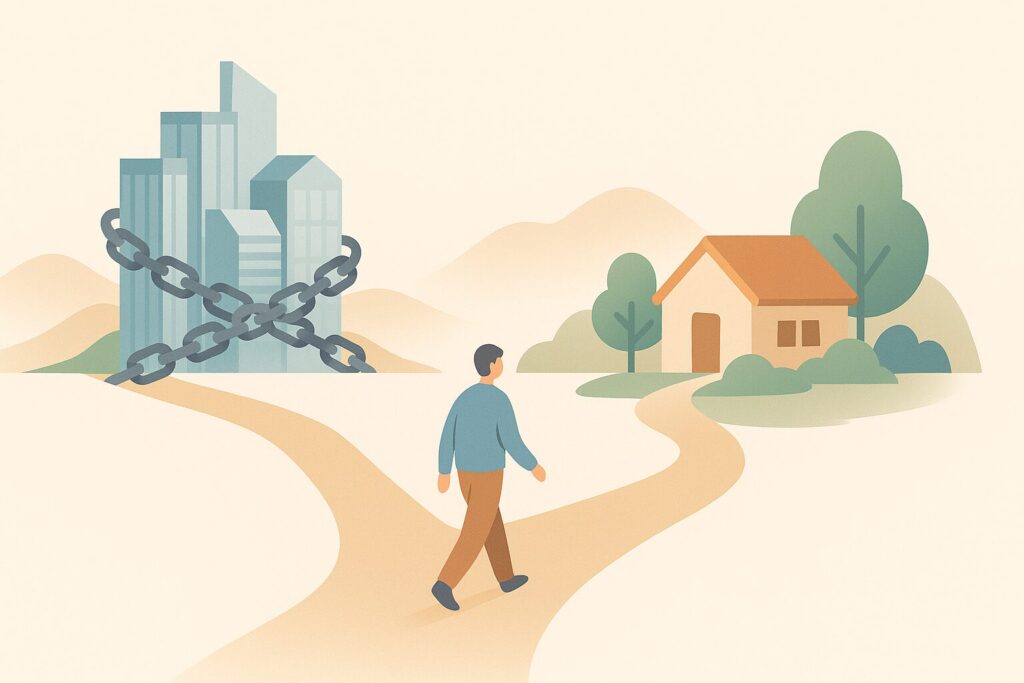
People often say that most pushes for expansion come from four main drivers:
- Inflation
- Investor pressure
- Fear of losing customers
- Ego
Among these, ego is especially tricky.
“I want people to think I’m impressive.”
“I want others to see that my company is big.”
“I want to look influential.”
This kind of desire feeds the beast and creates more 餓鬼(Gaki) — hungry ghosts.
But once you release that ego and start from the question, “What kind of day-to-day life do I actually want?”, your business decisions shift dramatically.
I have no desire to go back to a life spent feeding the beast.
I prefer to work small, and carefully.
To face my clients — and myself — with honesty.
And I find that this way of living feels far more abundant.
Conclusion: Which Do You Choose — Expansion or Fulfillment?
In the parable of the long chopsticks, heaven and hell share the same setting.
What differs is not the environment, but the direction of the heart.
In the same way, our work lives are not defined by business size, but by where our attention is aimed.
A way of working based on taking moves you toward hell, no matter how large your company becomes.
A way of working based on giving moves you toward heaven, even if you stay small.
This is not to say “expansion is evil.”
Rather, “Company of One” is inviting us to consider a different question:
Not “How big should my company be?”, but
“What kind of state of mind do I want to work from?”
The goal is not to become a slave to the beast — your company — but to work in a way that leaves you genuinely at peace.
The “right size” of a business is whatever allows that.
- Do you want to make your company bigger?
- Or do you want to make it a source of real fulfillment?
Your answer to that question will shape how you work from here on.