

The other day, I watched Disney’s *Elemental* with my sons.
In *Elemental*, there is a world where four “elements” live together: fire, water, earth, and air.
If fire touches water, it goes out. If water gets too close to fire, it evaporates.
Because of this, interaction between different elements is strictly forbidden—that is one of the core rules of their world.
In that world, a fire girl named Ember and a water boy named Wade are drawn to each other.
Even just that is enough to make it a moving story, but there was one scene in particular that stayed with me.
Summary: Five Points for Understanding How to Use Your Talent
| Your talent is “hard for you to see” | What is obvious to you can be valuable to others. The essence of talent lies in what you can do naturally. |
|---|---|
| Different elements (values) reflect your talent back to you | When you interact with people who have different backgrounds and viewpoints, your own “element” (essence, talent) becomes easier to see. |
| You find talent in “things you are praised for without trying” | If you carefully list out actions that are easy for you yet appreciated by others, the core of your talent starts to appear. |
| The Zen phrase 人人悉道器(Nin nin kotogotoku dōki nari) | meaning “Each person is fully equipped for their own path.” You don’t need to envy other people’s talent; using your own element is what feels most natural and powerful. |
| Working with your talent naturally creates 自利利他(Jiri rita) | meaning “benefiting self and others together.” When you use your talent, you feel fulfilled—and as a result, someone else benefits too. Sustainable work lives in this natural form of service. |
Let’s look at each of these more closely.
Talent Often Feels “Ordinary” to the Person Who Has It
There is a scene where Ember visits Wade’s family home.
A glass vase displayed in the house breaks, and Ember says, “I can fix that.” She then melts the glass with her own heat and restores it—more beautifully than before.
For Ember, this is “just something she always does.”
As someone who has lived her whole life as a fire element, melting and shaping glass is nothing special to her.
But to the water family, it is an astonishing talent.
Their eyes widen, they praise her, and they say, “We want to introduce you to the world’s greatest glassmaker,” treating her as if they’ve discovered someone extraordinary.
Watching this scene, I felt something click inside.
That same pattern shows up again and again in both work and life.
Talent Is Hard to Recognize from the Inside

When we hear the word “talent,” many of us picture something that is acquired through intense effort.
In reality, it’s often the opposite—true talent lies in the things you can do easily, without forcing yourself.
There is one tricky aspect of this, though.
Your talent feels normal to you.
You tend to think, “Anyone could do this.”
But those around you quietly know “Very few people can actually do that.”
Ember is a perfect example.
The more naturally someone can do something, the more likely they are to undervalue it.
Others (Different “Elements”) Help You Notice Your Talent
We are usually blind to our own strengths.
That’s why people with different backgrounds and values often help reveal our talent to us.
Just as Ember’s everyday skill as a fire element looks special through Wade’s water-element eyes.
We often only recognize our true “color” when we interact with different elements.
That realization is a powerful clue for how to use your talent.
How to Find Your Talent: “What Are You Appreciated for Without Trying?”

A simple question that helps in finding your talent is:
- When you explain something, people say, “That makes sense now.”
- When someone talks to you, they say they feel lighter afterward.
- You can talk calmly with people, even when it’s your first time meeting.
- You’re good at organizing complex information.
- Fine, detailed work doesn’t bother you.
These kinds of “things you just find yourself doing” are your element.
They are not skills you forced yourself to acquire; they are built-in traits—your gifts.
These gifts become the inner engine that supports your work.
It’s not that one type is superior to another—
they are simply different.
What matters is that you don’t reject your own talent (your element).
It may feel ordinary to you, but it is special to someone else.
That difference is what becomes value.
The Zen Teaching 人人悉道器(Nin nin kotogotoku dōki nari)and Talent
Zen has a saying, 人人悉道器(Nin nin kotogotoku dōki nari),
meaning “Every person has the capacity and potential to walk their own path.”
What is 人人悉道器(Nin nin kotogotoku dōki nari)?
- Fire has its own path.
- Water has its own path.
In the same way, each person has their own vessel,
and it is there that their power naturally appears.
So there is no need to envy someone else’s element.
Fire cannot, and does not need to, become water.
Fire has its own strengths as fire.
Why Using Your Talent Naturally Leads to 自利利他(Jiri rita)
In Buddhism, there is the idea of 自利利他(Jiri rita).
What is 自利利他(Jiri rita)?
利他(Rita) means benefiting others.
The teaching is: “Both self-benefit and benefit to others are important.”
These two are not about which comes first; they arise together.
When you work using your talent, 自利利他(Jiri rita) tends to circulate naturally.
Talent is something you can express without forcing yourself.
You can work at your own pace, in your own style, almost like breathing.
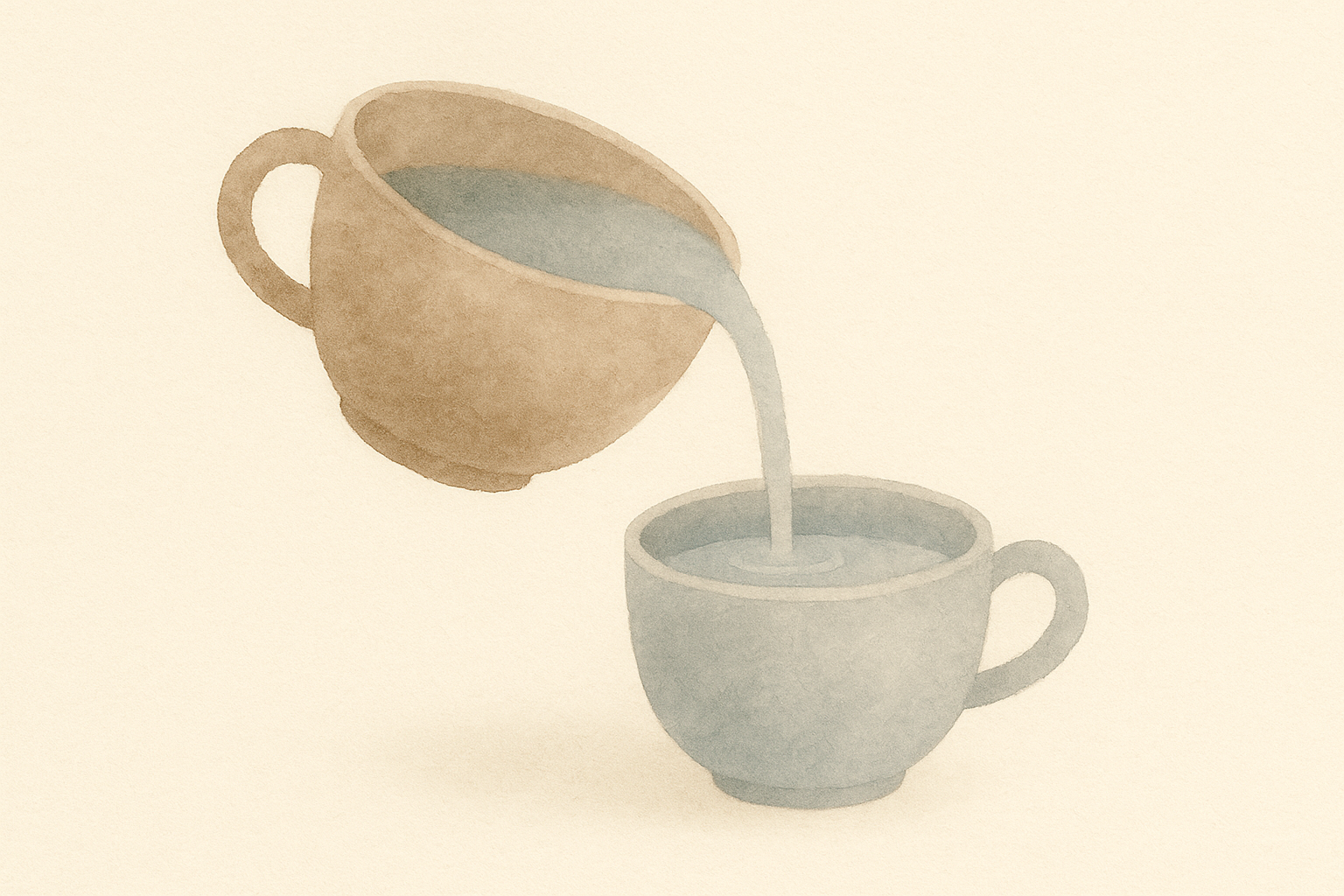
When you are using your talent, your inner “cup” fills with energy and love.
Humans Are Like Cups
In that sense, each of us is like a cup.
When your cup is full of water (love, energy), you can share it with others.
That is natural contribution.
But if your cup is almost empty and you still try to share, what happens?
A kind of subtle “I’m doing this for you” energy leaks out.
That’s why filling your own cup first is so important.
To do that, it helps to work in a way that uses your talent—to do what you enjoy and are naturally good at.
When your own energy is stable, it naturally becomes strength for others, too.
That cycle is what 自利利他(Jiri rita) is really about, I feel.
Forced Altruism Is Exhausting. Natural Altruism Is Sustainable.
For example, I can “speak,” “explain,” and “organize ideas into words” quite naturally.
For a long time, I didn’t consider that a special strength at all.
But as I kept running seminars and sharing information,
I began hearing comments like,
“That was very easy to understand,” and “I finally get it now.”
It’s not something I worked hard to acquire; it’s something I’ve naturally done since I was young.
That’s why it doesn’t feel forced, and it seems to help people.
Using your talent in service doesn’t drain you.
It’s like “fire remaining fire.”
I am sure you have something similar.
Not a skill you forced yourself to learn, but a trait that simply overflows.
There you will find clues to a way of working that you can sustain.
Working in a Way That Uses “Who You Already Are”
Sometimes we find ourselves trying to become “a different element”—someone we are not.
Of course, understanding other elements is important.
But if you force yourself to become something else, you eventually feel suffocated.
In the movie, Ember is able to create a beautiful vase
because she uses her talent in a natural way.
Humans are no different. You don’t need to fundamentally change who you are.
- Fire can create value that only fire can create.
- Water can work in ways that only water can work.
You don’t have to become someone else.
You can work as yourself.
We often hear “Be yourself” or “Value your true self.”
In this context, it means: “If you were born as fire, notice your talent as fire and refine it.”
“Being yourself” is not about staying the same forever; it’s about letting your own material grow and shine.
There you will find the way of working in which your talent shines most beautifully.
In Closing: What Is Your Talent—Your Element?
*Elemental* is a story about different elements meeting and interacting.
Through those interactions, Ember slowly becomes aware of her own value.
We are the same.
When we live only in our own inner world, our talent feels too ordinary to notice.
But when we meet others and encounter real differences, our value often comes into view.
Zen teaches:
人人悉道器(Nin nin kotogotoku dōki nari)—
Each person has the vessel for a path that only they can walk.
It’s not about good or bad.
It’s simply that each of us is different.
And those differences are precisely what create value.
What can you do so naturally that you barely notice it?
That may be the talent—your element—that someone, somewhere, is quietly waiting for.