

“Is it uncool that I’m running a small company…?”
“Should I hire more people, grow revenue, and move into a big office…?”
Have you ever felt that way?
In the business world, there is a strong atmosphere that “a company is only legitimate when it becomes big.”
For some people, that is a great dream and the right path.
But that doesn’t necessarily lead to your own happiness.
In this article, I’d like to share—from my own experience—the sense of “pride in working small.”
When Chasing Growth Became Painful
I used to believe that “a company must grow.”
Hire more staff, increase sales, move to the next stage—
At first, that sense of growth felt exciting. I felt like I was moving forward.
But at some point, that “growth” turned into a “quota.”
Every new hire meant another life I had to protect, and the weight of responsibility grew.
Even when I was making proposals, a question kept echoing in my mind:
“Is this really for the client, or is it just for our sales target?”
Looking back, I realize that during that period I was chasing “revenue to keep the company alive,”
not “results that genuinely support the client’s happiness.”
And I could feel something inside me being worn down, little by little.
Escaping “Beast-Feeding Management”
What changed me was a book called “Company of One” (original title of “Stay Small”).
In it, the author writes:
If you grow a company too large, it becomes a ‘beast.’
The owner ends up working just to feed that beast.
Higher sales bring higher fixed costs.
Before you know it, you’re exhausting yourself simply to sustain the machine.
That was exactly my situation.
I was no longer doing “work I love.”
I was doing “work to feed the beast (the company) with money.”
When I realized that, I stopped and asked myself:
Instead of working to raise a beast, why not do work I personally find meaningful and valuable?
A Small Company Is Not “Incomplete”
Back then, I believed that “a small company = incomplete.”
But when I revisited Darwin’s theory of evolution, I realized how mistaken that view was.
We often imagine “evolution” as a straight line moving upward.
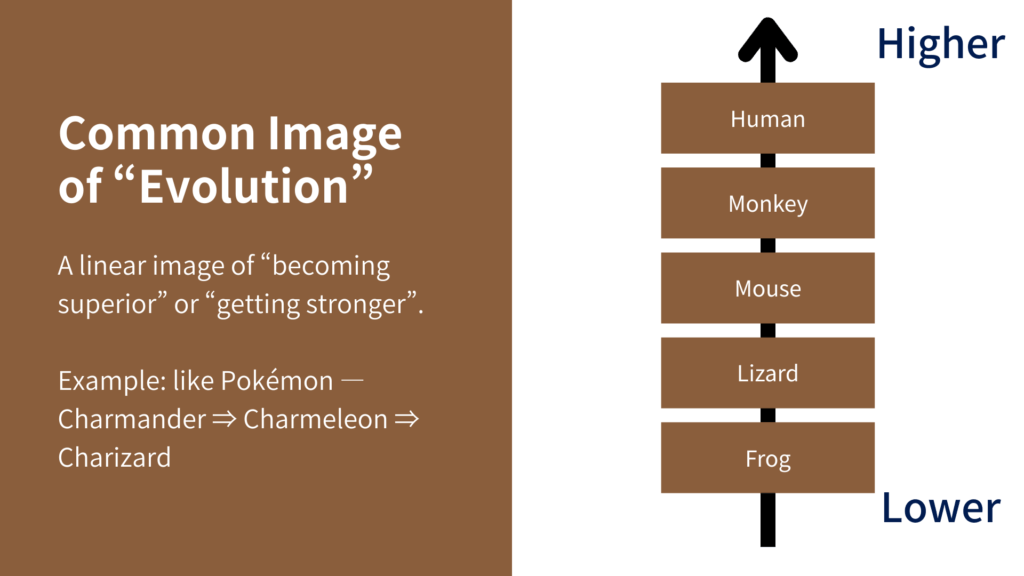
However, real evolution branches out. Each branch adapts to its own environment.
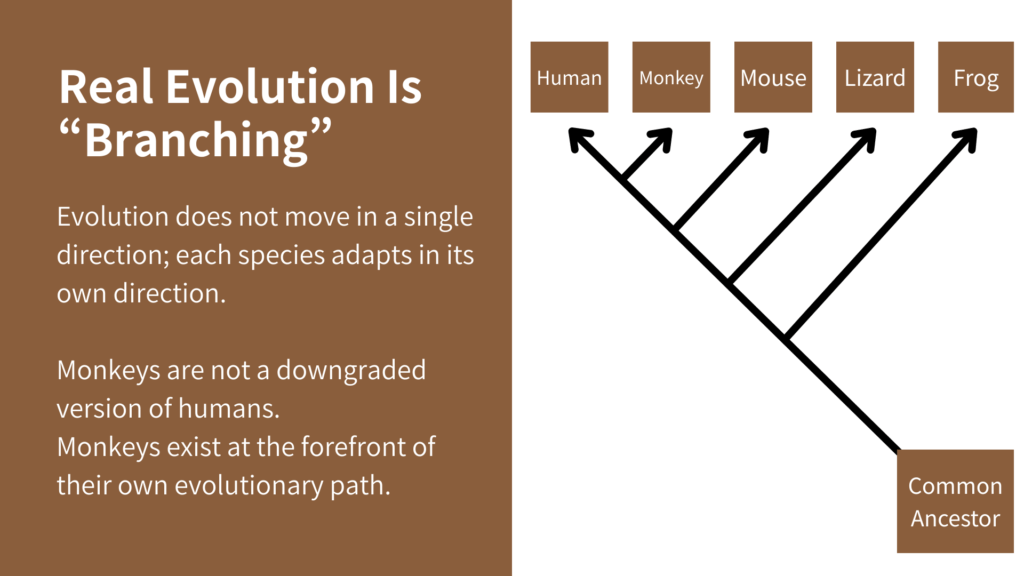
For example, monkeys do not exist in order to “one day become human.”
Monkeys stand at the cutting edge of their own evolutionary path.
Humans stand at the cutting edge of a different path.
Neither is above or below the other.
Companies are the same.
Large corporations follow their own line of evolution.
Small companies follow a different line of evolution.
Both are at the “frontline” of their respective paths.
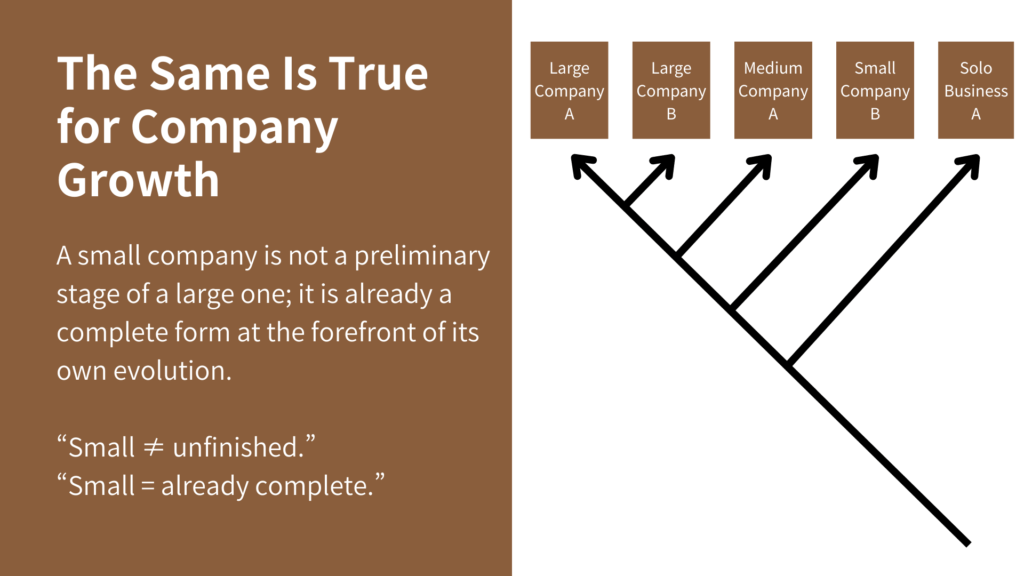
So a small company is not a “half-finished version of a big one.”
It already is “the forefront of evolution for that company.”
The Courage to Let Go of “More”
When I was focused on expansion, I was always chasing:
“More!” “Still not enough!”
But there is no finish line on that road.
Each time you hit a target, a new one appears.
In that cycle, your heart never truly rests.
At that time, I remembered a Buddhist teaching:
たとえ貨幣の雨を降らすとも、欲望の満たされることはない。(Tatoe kahei no ame o furasu tomo, yokubō no mitasareru koto wa nai)
This is not a moral warning against wealth.
It is an observation about the nature of desire itself.
No amount of money can satisfy desire, because desire always moves the definition of “enough.”
Those words hit me hard.
No matter how much you gain, if the inner voice of “more” never stops, you will never feel content.
That’s when I encountered the Eastern idea of “knowing sufficiency.”
“Knowing Sufficiency” Is Not the Same as Enduring
When people hear “know sufficiency,” they often interpret it as:
“Just put up with your current situation.”
But I don’t think that’s the true meaning.
In other words, discovering “what kind of work and life truly make your heart feel full.”
When unnecessary desires subside, energy is no longer wasted,
allowing you to focus on what truly matters,
and as a result, you move closer to the state you desire.
For me, that feeling shows up when I’m sharing my ideas and know-how—
through YouTube, blogs, and podcasts.
Those are the moments I feel most aligned with myself.
And interestingly, once I began to focus on what I enjoy,
revenue naturally stabilized and I was blessed with great clients.
Instead of chasing numbers, I chose to “focus on what I love and do well.”
That became my version of “management based on knowing sufficiency.”
Small Companies Are Beautiful
Small companies have strengths that only small companies possess.
You are close to your clients.
You can see their faces.
You can work at your own pace and with care.
These are advantages that large corporations simply cannot imitate.
“Size” has nothing to do with “happiness.”
The ideal size is the one at which you can work in a way that feels right for you.
On this site, “How a CEO Works – With a Touch of Zen,”
I value this style of work: “small, but deeply fulfilling.”
You don’t have to grow bigger.
You don’t have to move faster.
If you can work in a way that feels true to you,
I believe that is the most “cool” form of success.